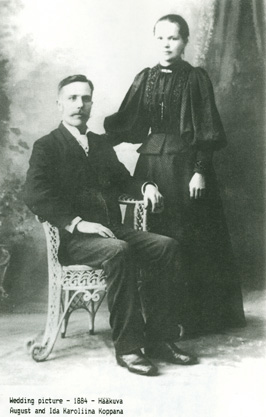
When August and Ida Koppana arrived in America from Finland in 1884, they first settled in Portage Entry, Michigan, where the Ruonavaaras who earlier had moved there from Finland had started a store. The Ruonavaaras lived on the first floor of their house, the same floor as the store, but on the second floor they had two more rooms and those were rented to August and Ida. This young couple went to the City of Calumet later on that year in order to get married there, and then August started to do commercial fishing in order to provide for his family.
However, he soon got a position as a machinist at a sawmill owned by Charles Hebard & Sons, an outfit acquired by Henry Ford in 1926. As a result of this, they had to move to Pequaming in Michigan.
His working hours were from six o’clock in the evening until six o’clock in the morning. He saw to it that all the machinery was in working order and all the necessary repairs were done before the sawyers came to work.
To begin with, the company gave them a place to live with just one bedroom. But when the family increased in size they moved to their own house, which the company financed by giving August a loan. The lot was large and on Lake Superior. The house had four bedrooms, a large kitchen and a main room which served as a dining room, living room and even as a playroom. Out in the yard was an outbuilding with space for a couple of cows, a chicken coop and an outhouse. One of the bedrooms was always rented out to the newcomers from Finland.
There was always enough to keep August busy, especially during the winters when the sawmill was not in operation. The other men left for logging camps but August was handy and resourceful. He worked as a carpenter and cabinetmaker, knitted fishnets (casting the weights for them, too), and busied himself even as a cobbler to provide for his family over the winter months. He never interfered with the care of the children or with their upbringing but he made skis and sleighs for them.
August was a quiet and peaceful man leading his own life and thinking his own thoughts, laughing seldom. But when he did, it really came from his heart.
As a young man he had done some drinking but after he got married to Ida, he gave it up altogether. On the other hand, he started to organize prayer meetings, during the summer out in the yard and in wintertime in the main room where there was a lot of hymn singing and where August read the Bible with his loud and clear voice. These prayer meetings were quite welcome to many newcomers from Finland especially so since there was no church nearby. Later, in 1912, the company gave the necessary lumber for building a school and where then on Sundays there was a Sunday school for the youngsters and prayer meetings for the older folks and where Rev. Heideman came to preach.
Ida, with her many children, looked after the household, took care of the roomers and taught the children to read and did everything possible to guarantee a good education for the children. Four of her children went through Hancock’s Suomi College and three of them continued even further their university studies. Ida was also the midwife for her neighbors. She was tiny but fast moving and good-natured and had a good sense of humor. She was always ready to help her neighbors, whether acquaintances or strangers.
One stormy fall morning August had noticed that a large fishing vessel had shipwrecked on Lake Superior. He left immediately to help with his own boat. He managed to save most of the men but, unfortunately, one man drowned. One of the men who had been saved, one Matti Kallio, never went fishing any more after that. August was rewarded with a golden watch by the Ford Sawmill Co. for his feat of courage.
August worked for the company for 44 years. When he retired, he sold the house and bought a small farm in Aura. When Ida was left alone, she acquired a house for herself at L’Anse.
August was 77 when he died and Ida was 86 when her time came.
When I interviewed their daughter Alma Finley in connection with my visit to Michigan in the summer of 1985, Alma was a very brisk 91-year old.

August and Ida Koppana later in life, probably taken
somewhere along the east side of Keweenaw Bay
An Old Family Tale from Finland in the 1800s

Iisakki Pörhöläs’s wife Priitta had a brother Johan Erkki Vallo who was the master of Jussila family estate at Laivajärvi. His second wife was Eeva Maria Kiemunkivaara from Sodankylä (born 1842 and most likely of Lappish origin, judging by her name). Her daughter was Ida Karolina who later on went to America with August Koppana, eventually to marry him there.
This lady, mother of Ida Koppana, had to leave the family estate of Jussila after the death of her husband Johan Erkki and later on settled in the cottage of Saarenpää, belonging to the farm of Suutari. Eeva Maria was famous for her spiritual powers.
Once, at her more advanced age, Eeva Maria decided to go visiting to the farm of Krekula, and she up and died there. The good folks of Krekula were busy with fishing and did not have time to take her body to the church so they made a deal with one Kalle Kämppä about her transportation. Kalle was vaguely related to Eeva Maria, Kalle’s wife being Karuliina Pörhälä by birth and her uncle was the former husband of Eeva Maria, Johan Erkki Vallo, now deceased.
Since everyone was aware of Eeva Maria’s spiritual powers, a man who was not afraid of spirits was needed for the transportation.
So, listen to this: when Kalle was driving his horse Pulle towards Krekula, a distance of some six kilometers, every inch of it gloomy wilderness, you would imagine that a person could get some funny feelings, but not Kalle—he was a man of iron nerves. But when they got nearer Ruononoja Creek, the horse started to act up, snorting and finally stopping altogether. Kalle was wondering what goes on and tried to look along the side of the horse to find out what would make the horse behave that way. And lo and behold, there came Eeva Maria, getting closer and closer. The horse was getting pretty hard to control by now, kicking and snorting while Kalle was trying his level best to calm him down: “Pulle, come on, don’t panic, it’s just Eeva Maria, let her pass, come on now, it’s all right.” And Eeva Maria passed, gave a nice smile to Kalle and walked on. Kalle let go of the bridle and they continued the ride but Kalle never looked back . . . you can’t do that when you have met someone mightier than you are yourself.
Kalle drove on to Krekula, picked up the departed and said: “I already met Eeva at the Ruononoja Creek but I thought I’d better drive on all the way to the farm because that’s what the deal calls for.”
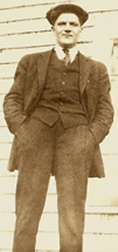
Max Finley Sr, c. 1924
> > ENLARGE |
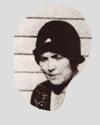
Alma Jenny Koppana Finley, 1929 |
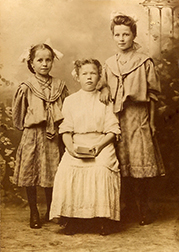 Alma Jenny Koppana, right, c.
1905
Alma Jenny Koppana, right, c.
1905 > > ENLARGE |
MAX FINLEY SR. GENEALOGY/TIMELINE
(updated 1.1.2012)
BORN: MAKS VÖÖBUS, 04.04.1887 (KURISTA, LIVONIA-LIVLAND, near Dorpat which is now known as Tartu, Estonia.)
Relevant maps > >
DIED: 18.07.1964 (GWINN, MICHIGAN, USA)
Background info: The earliest known whereabouts of the Vööbus clan are set in the very late 1600s at the Kalamehe (Fisherman) farm of Kivilõppe village on the shore of Lake Võrtsjärv; later, that same farm was known as Rebbi (or Rebi or Räbbi).
During the period 1822-1826 all of the peasants in South Estonia (i.e., Livonia) who had been liberated from serfdom were given family names (having earlier taken their names from their farm, and position within).
Thus Hindrek Vööbus (b. 1827) was the first born with the Vööbus surname.
In 1846 Hindrek’s brother Jaan (b. 27.11.1814, d. 7.10.1897) and his family relocated to Tarvastu Manor,where he worked as a taskmaster. In 1851 they then moved to Aru Manor (Tartumaa County, Neo Parish) where Jaan worked as a taskmaster and ranger; then in 1856 moved again to Kurista village (Tartumaa County, Võnnu Parish) where Jaan worked as a ranger; he became owner of the farm as of 1862.
Jaan's brother Hindrek followed suit, moving to Aru Manor in 1855 and also to Kurista in 1857.
Later they lived in the neighboring village of Hammaste. Jaan’s son Johan (father of Maks, see details below) stayed in Hammaste for a while before going west to Kastre (Võrumaa County, Kanepi Parish), and then back east again to Kurista.
Relevant photos > >
NOTE ABOUT DATES: All listed in conjunction with Estonia are from the old Julian Calendar
GEOGRAPHICAL NOTE: References are to historical (not contemporary) Estonia; as late as the early twentieth century, Estonia consisted of 9 counties, which were further subdivided into 106 parishes. Within each parish were various manors, the respective definitions of which can be found on the web at <http://www.mois.ee/english/types.shtml> and <http://www.mois.ee/english/meaning.shtml>.
Max’s father was JOHAN VÖÖBUS (b. 5.02.1844, d. 1.05.1908 and buried in VÕNNU, TARTUMAA)
JOHAN VÖÖBUS was the brother of the grandfather of ARTHUR VÖÖBUS [1909-1988], famous Estonian- American scholar & historian; these two brothers married sisters
1864—JOHAN started working as a schoolteacher
22.05.1866 to 18.12.1866—The TARTU/VÕRU UPPER (SYNOD) CHURCHWARDEN DEPARTMENT filed a complaint against teacher JOHAN VÖÖBUS, who was blamed for the cold schoolhouse, for breeding pigs in the
schoolhouse, and skipping prayer sessions in church; the VÕNNU churchwarden, E. BARON NOLCKEN, decided to allow him to continue working thru St. George’s Day (23.04.1867)
1867-1882—JOHAN taught school in KARSTE PARISH school; was likely hired because of his “good singing voice” (based on similar accounts)
1868-1873—The KANEPI male choir (KANEPI SINGING SOCIETY) was founded to include JOHAN (singing bass); this professional choir was very active and their concert tours took them as far as FINLAND & RUSSIA. Their first big concert was in 1871 in TARTU. At Christmastime in 1873 their concerts took place in ST. PETERSBURG. Most choir singers worked as teachers in KANEPI PARISH and had big problems getting free time for this trip, because the pastor of KANEPI church generally did not allow for travel. The trip itself was long and hard, requiring a sleigh ride to PIHKVA (PSKOV), then travel by rail to ST. PETERSBURG. Choir singers wore black jackets (symbolizing a long slave time) with a green collar (symbolizing hope) and with red edges and belt (symbolizing the glowing fire of liberty).
Historic photos of both the Kanepi male choir (inc. Johan Vööbus) & teachers in Vonuu Parish (inc. Johan’s oldest son David, Maks’ brother) > >
1872—JOHAN was one of the establishers of the KANEPI LIBRARY SOCIETY; his specialty was collecting folk legends
1877—JOHAN joined the ESTONIAN PENMAN’S SOCIETY
1882—JOHAN taught at the KURISTA school (in VÕNNU PARISH)
1886-1894—JOHAN christened children (as a schoolteacher) in VÕNNU PARISH
1902—JOHAN helped found the VÕNNU SINGING AND ACTING SOCIETY, which still functions today
1894-1908—JOHAN, along with children LOVISA and MAKS, changed membership from the VÕNNU church congregation to the ST PEETRI CHURCH in TARTU (both were Lutheran churches); JOHAN was likely involved with music instruction at the TEACHER’S SEMINAR in TARTU (est. 1828 and ultimately united with TARTU UNIVERSITY in 2001) Brief history of St. Peetri Church in Tartu > >.
Max’s mother’s maiden name was ANN ARIKE (b. 13.11.1841, d. 4.07.1894)
JOHAN VÖÖBUS and ANN ARIKE were married on 11.04.1865, settling first in HAMMASTE and later, in KARSTE MANOR (VÕRUMAA COUNTY, KANEPI PARISH) and then KURISTA; children subsequently born as follows:
LOVISA (Born 1866 in KURISTA, d. 24.10.1948 in VÕNNU PARISH)
MARI or MARRI (Born 1868 in KARSTE, Died 7.02.1893)
DAVID (Born 1871 in KARSTE MANOR, Died 1933 in SIBERIA)
LYDIA (Born 1873 in KARSTE MANOR, Died 5.05.1894)
JULIUS DEMETRIUS (Born 1875 in KARSTE MANOR, Died before 1920 in STARAJA RUSSIA)
EMILE (Born 1877 in KARSTE MANOR, Died 1962 in Aa village)—Brief Bio of Emilie > >
LEO (Born 23.08.1879 in KARSTE MANOR; Died 17.07.1945 in VILJANDI, ESTONIA;
VASTEMÕISA PARISH)
ALMA (Born 1882 in KURISTA, Died 25.05.1894)
MAKS (see below)
MAKS (Born in KURISTA 23.03.1887 on Old Julian calendar or 04.04.1887 on New  Gregorian calendar); godparents were a “farmhand,” a “farmer,” and a “farm girl”; christened on 13.04.1887 (old calendar) Gregorian calendar); godparents were a “farmhand,” a “farmer,” and a “farm girl”; christened on 13.04.1887 (old calendar)
All children christened as Lutherans. One brother rumored to be as tall as seven feet.
NOTE: Thus, at about the time MAKS was seven, his mother died from typhus, following the deaths of two sisters from typhus, one sister from influenza, and the death of his grandmother ANN; soon after (when MAKS was about ten), his grandfather JAAN died and (when MAKS was about twenty) father JOHAN died
MAKS rumored to have lived with or very close by a sister at some point in time (probably sister LOVISA who was living in TARTU)
MAKS had a cousin named JOHAN KOIV (a postal official in NARVA and the TARTU) who may also have been known as JOHN RIEV. He bought a house in TARTU in 1917 for his parents to spend their last years. LOVISA lived in this house 1918-1928 and helped JOHAN KOIV manage the house (by 1933, thirty-three people were living there, including six coachmen, as there were horse stables nearby)
MAKS received a passport (a permit to move out of his parish, valid for one year) on 06.09.1905, which was the day after the 1905 Russo-Japanese War ended; his father & sister also received similar passports simultaneously
MAKS worked as a laborer and since he, unlike his father & sister, did not renew his passport one year later, MAKS may well have moved to Russia and worked on the construction of the Trans-Siberian railroad, as rumored
MAKS was conscripted into Russian military (artillery battalion) on 29.10.1908 and served near the Japanese border as "writer of staff" (clerk?) from January 1909 to September 1911
MAKS rumored to have gone AWOL from the Russian military for reasons unknown
MAKS officially wanted on criminal charge possibly related to the political prosecutions following 1905 uprisings in Baltic region (as MAKS was rumored to have been a card-carrying communist) or else his own misadventures while in military service
In January 1911 LOVISA sent a postcard to JOHAN KOIV where she noted that she had received a postcard from MAKS but couldn't understand where MAKS was and surmised that he was doing badly
MAKS fled to NEW YORK CITY by sailing on the S.S. CZAR, arriving on October 28, 1912 after a two-week trip and apparently staying in the NYC area until late 1914—perhaps by joining the existing Estonian community on city’s East Side
(NOTE: The S.S. CZAR was built in 1912 for the RUSSIAN AMERICAN LINE and commenced sailings that same year from LIBAU (LIEPAJA), LATVIA, to NYC via COPENHAGEN and HALIFAX.)
Photo of the S.S. Czar >>
Sometime thereafter NYC landing MAKS changed his name to MAX FINLEY (as he, according to word-of-mouth, wanted “a good Irish name”)
MAX migrated to CANADIAN SOO (SAULT STE. MARIE, ONTARIO) in Nov 1914 for reasons unknown (though possibly related to the start of World War I but more likely due to his knowing somebody in the area); at the Soo, he managed a pool/billiard hall
MAX returned to USA by ferryboat (to SAULT STE. MARIE, MI) in Oct 1917 for reasons unknown
MAX played in an orchestra and met ALMA “JENNY” KOPPANA during a Finnish dance performance in the SOO area where JENNY had come to help raise the newborn of her older sister HELMI IMPI, possibly also working in the area
MAX married JENNY in CANADIAN SOO (ALGOMA DISTRICT) in 1919, and while she was pregnant with her first child, MAX went to DETROIT to work as a machinist in the auto factories; there, MAX boarded in the home of Mary Norris, along with four others including Estonian JOHN PIVEL, ten years his junior
First daughter NINA born 1920, SAULT STE. MARIE
MAX apparently didn’t care for DETROIT, returning north to reunite with his family, which then moved to PEQUAMING, MI
MAX received “first citizenship papers” in L’ANSE, MI in April 1924 but papers were lost; naturalization was never petitioned for thereafter
More children born in PEQUAMING (MAILA ’22, DONNA ’25 , DELLA ’26)
MAX left PEQUAMING (ca. 1926), rumored to have spent some time in CHICAGO after which he surfaced in GWINN, MICHIGAN
Family reunited with MAX in GWINN c. 1928
Rest of kids born in GWINN (MAX JR. ’29, NORA ’32, LEO ’34, ROBERT ’36)
(Note: NORA IS THE MOTHER OF GERRY MANTEL, WEBSITE AUTHOR)
MAX frequented local community center in GWINN, did much piano tuning in the area and also managed his own greenhouse at home; was apparently a homebody who rarely travelled outside of GWINN
Photo of Max in his greenhouse, c. 1950s >>
MAX always spoke highly of and longed for his Estonian homeland
MAX was proficient at chess; self-taught on Spanish guitar
MAX died during the summer of 1964 while taking sauna in GWINN
MAX wished to be buried as a Russian Orthodox (according to his son, MAX JR.) but was buried instead as a Lutheran, in GWINN

1929 photo of Max Finley's wife Alma Jenny Koppana-Finley with
five of their eight children: (back, l to r) Dana, Maila, and Max Jr.;
(front) Della and Nina.
>> ENLARGE

Nora Finley (in front passenger seat), daughter of Jenny and
mother of website author Gerry Mantel; photo from Gwinn, MI c. 1948
>> ENLARGE
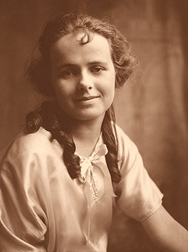
Mamie Carolina Koppana, sister of Jenny, b. 1906, Pequaming, MI
>> ENLARGE
Return to Top
< < Item
< < HOME
Personal photos from Historic Pequaming
INTERESTING ARTICLE on Henry Ford’s role in Pequaming history |